
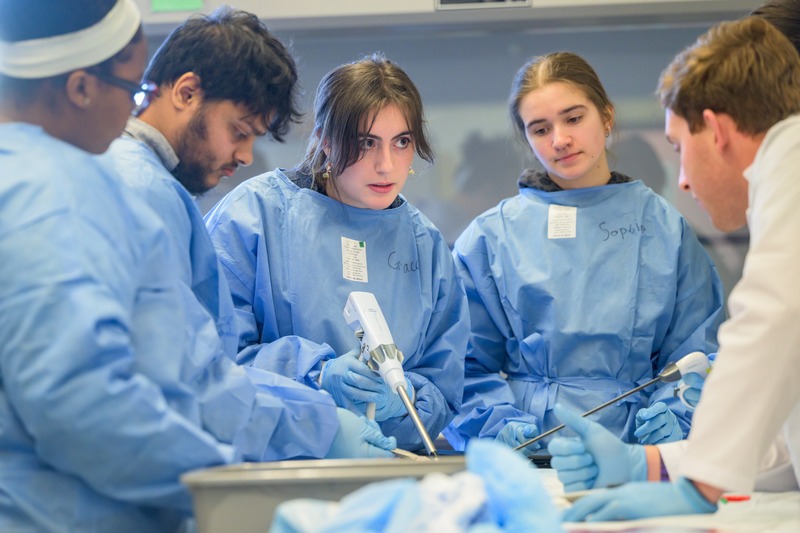
UD partners with med tech sales representatives to give students hands-on experience and foster mutual growth
Simulating a sleeve gastrectomy, a surgical weight-loss procedure that reduces the stomach to the size and shape of a banana, is not a typical topic for a sophomore-level biomedical engineering lab. But in mid-February, students in Sarah Rooney’s BMEG260 Introduction to Medical Device Design course got hands-on experience with the same devices that surgeons employ, practicing on pig stomach tissue sourced from a local butcher.
“The course is designed to help students form their professional biomedical engineering identity earlier and gain a broader understanding of career opportunities in the field,” said Rooney. The course curriculum emphasizes how device design decisions are shaped by user needs, the clinical context and regulatory approval pathways—knowledge that becomes indispensable when they move into design work in their junior and senior years.
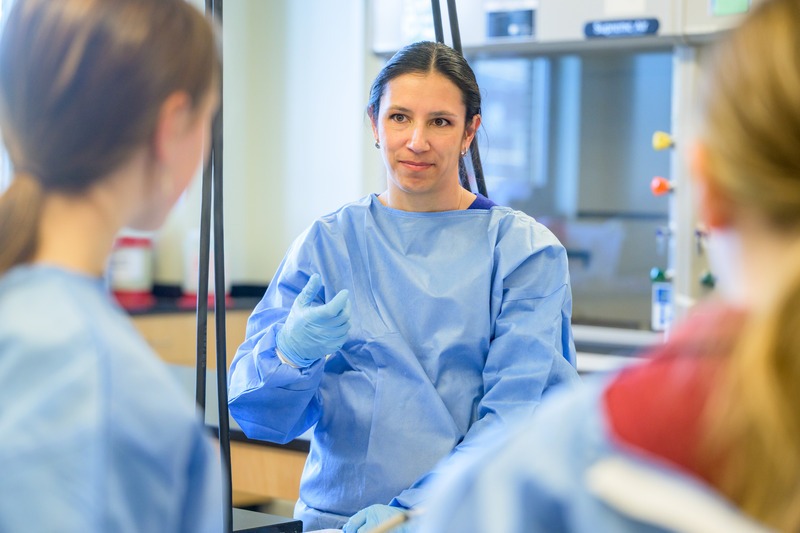
Associate professor Sarah Rooney designed the introductory course on medical devices and co-developed the unique lab with J&J MedTech.
Over the semester, students explore three types of medical devices. While two change each year, the surgical stapler remains a constant thanks to an ongoing partnership with Johnson & Johnson MedTech.
J&J MedTech sales training representatives (STRs), recent college graduates in a highly selective 14-month program that trains them to become independent sales professionals, lead hands-on lab sessions. After providing a short introduction to surgical stapling, the STRs guide the class through exercises with J&J MedTech’s line of staplers. These staplers are used on internal organs and differ greatly from the devices used to close skin wounds.
Students start by practicing on foam models before moving on to pig tissue. They handle staplers of all shapes and sizes: one simply staples, others staple and cut simultaneously, and a circular stapler connects segments of tissue. Surgeons select appropriate staplers based on the type of tissue and the nature of the procedure.
STRs guide the students through each step, demonstrating the devices before letting the students fire them themselves. Many students were surprised to learn that the staples are tiny titanium pieces that do not biodegrade and that the entire stapler is discarded after a surgical procedure.
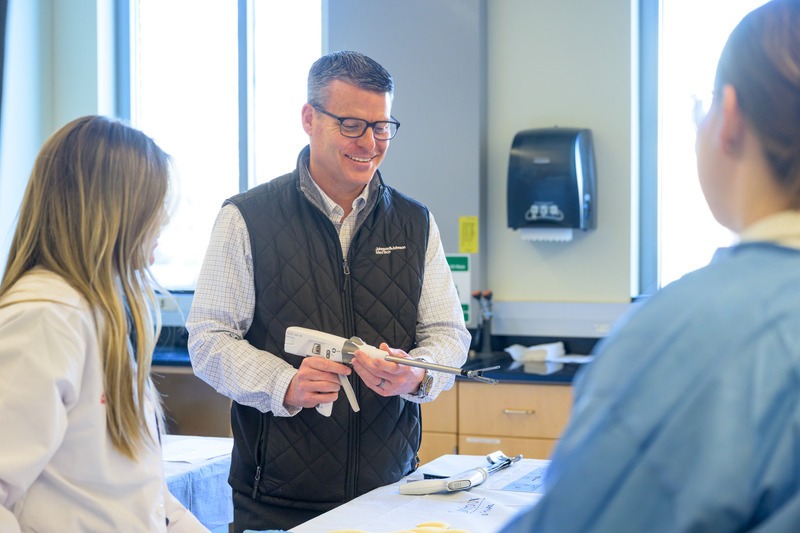
J&J MedTech’s Glenn Magrini (black vest) co-developed the lab with Rooney and helps support the STRs during their teaching experience.
Rooney said that one of the most powerful aspects of the lab, now in its fourth year, is exposing students to career paths they might not otherwise consider. “Many had never heard of technical sales or thought it was an option,” she said. “They realize, ‘I could actually be in the operating room, standing side by side with a surgeon, without going to medical school.’ That kind of exposure expands their thinking about what’s possible in biomedical engineering.”
“It’s a win-win,” said Glenn Magrini, senior manager of customer success and conversion initiatives at J&J MedTech and a UD alumnus. “Students get early exposure to real-world devices, and our STRs get a chance to teach in a classroom setting, which strengthens their ability to train surgeons, nurses and other professionals later on.”
Cathleen Fisher experienced the lab both as a student and a teaching assistant.
He noted that the closeness in age between STRs and the students helps foster an interactive learning environment. Students appreciated that the STRs shared their phone numbers and offered to connect on LinkedIn, creating the opportunity for continued mentorship and building a professional network.
For seniors Taylor Wenner and Cathleen Fisher, the lab’s impact was lasting. Both took the course during their sophomore year and experienced the lab again this year as BMEG260 teaching assistants. Fisher ranks the lab as one of her “top 10” experiences at UD and says the experience reinforced her interest in pursuing a career in medical device sales after graduation. Wenner is considering applying to J&J MedTech’s STR program.
Not every student will pursue a sales career. But the early exposure to medical devices, and to the professionals who support their use, adds another dimension to how they think about their field.